
Table of Contents
Introduction
How to stay consistent is one of the most powerful skills you can develop in today’s fast-paced world. Motivation comes and goes, but consistency is what creates real results. Whether your goal is fitness, studying, business growth, content creation, or self-improvement, long-term success depends on your ability to show up every single day.
Learning how to stay consistent is not about motivation; it is about building systems that support daily action.
Many people start strong but quit after a few weeks. The difference between successful people and average performers is not talent — it is consistency. When you learn how to stay consistent, you build discipline, improve focus, and create unstoppable momentum.
In this complete guide, you will learn practical strategies, psychological principles, and proven systems that help you stay consistent even when motivation disappears.
Why Consistency Is More Important Than Motivation
Motivation feels exciting. It pushes you to start. But it is temporary. Consistency, on the other hand, is stable and reliable.
When you rely only on motivation:
- You work only when you feel like it.
- Your progress becomes irregular.
- You lose confidence after small setbacks.
When you build consistency:
- You take action regardless of mood.
- Small actions compound over time.
- You create habits that run automatically.
Consistency builds identity. If you show up daily, you begin to see yourself as disciplined, reliable, and focused.
The Psychology Behind How to Stay Consistent
Understanding how to stay consistent requires knowing how habits work.
Every habit follows a loop:
- Cue
- Routine
- Reward
For example:
- Cue: Alarm rings at 5 AM.
- Routine: Morning workout.
- Reward: Energy and mental clarity.
When this loop repeats enough times, your brain automates the behavior. That is why consistency is not about willpower — it is about building systems.
1. Start Small and Make It Easy
One of the biggest mistakes people make is starting too big.
Instead of:
- “I will work out 1 hour daily.”
Start with:
- “I will work out 10 minutes daily.”
Instead of:
- “I will study 4 hours.”
Start with:
- “I will study 30 minutes.”
Small actions reduce resistance. When tasks feel easy, you are more likely to stay consistent.
Consistency beats intensity.
If you truly want to understand how to stay consistent, you must focus on small daily actions instead of big temporary efforts.
2. Focus on Identity, Not Goals
Goals are temporary. Identity is permanent.
Instead of saying:
- “I want to run a marathon.”
Say:
- “I am becoming a disciplined runner.”
When you shift identity:
- You act in alignment with who you want to become.
- Skipping becomes harder because it conflicts with your self-image.
If you want to learn how to stay consistent, focus on becoming the type of person who shows up daily.
3. Create a Fixed Schedule
Consistency improves when actions are tied to time.
Examples:
- Workout at 6 AM daily.
- Write content at 8 PM daily.
- Study at 7 PM daily.
When you remove decision-making, you reduce mental fatigue. Your brain stops asking, “Should I do it today?”
The answer becomes automatic.
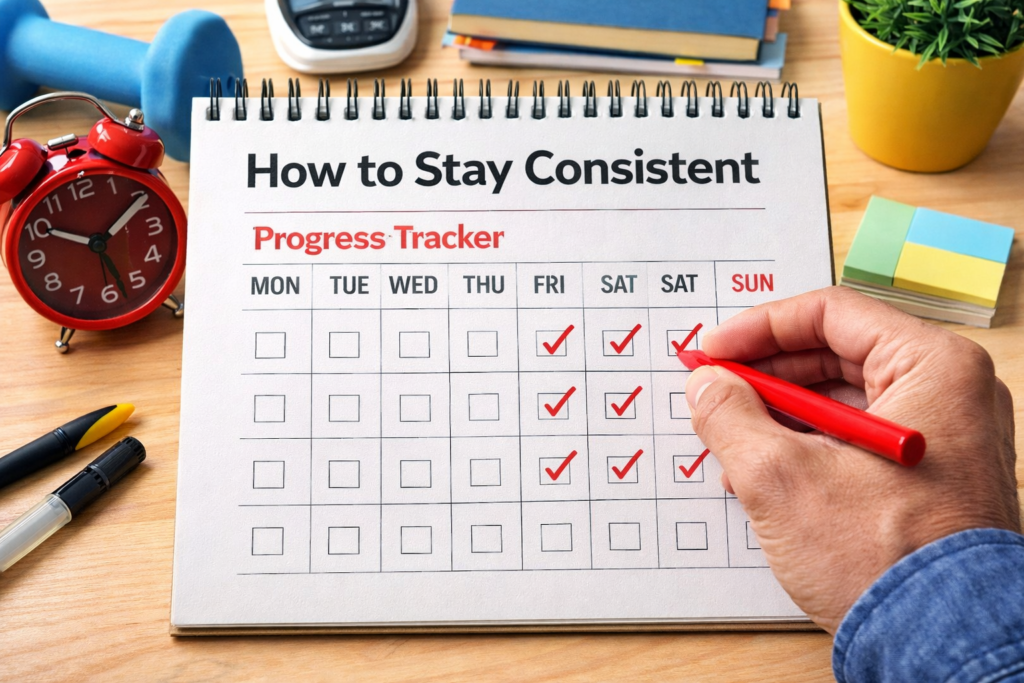
4. Track Your Progress
Tracking increases accountability.
You can:
- Use a habit tracker.
- Mark a calendar.
- Maintain a progress journal.
Seeing streaks grow builds momentum. Breaking streaks becomes psychologically painful, which helps you stay consistent.
Never break the chain.
5. Remove Distractions
Consistency becomes difficult when distractions dominate your environment.
To improve consistency:
- Turn off unnecessary notifications.
- Keep your phone in another room while working.
- Create a clean workspace.
- Use website blockers.
Environment design is powerful. Make good habits easy and bad habits difficult.
6. Follow the 2-Minute Rule
If you feel resistance, apply the 2-minute rule.
Tell yourself:
“I will do this for just 2 minutes.”
Once you start, momentum builds naturally. Starting is the hardest part. The 2-minute rule eliminates mental barriers.
7. Build Systems, Not Just Goals
Goals tell you what to achieve. Systems tell you how to achieve it.
Example:
Goal:
- Lose 10 kg.
System:
- Walk 8,000 steps daily.
- Eat protein in every meal.
- Avoid junk food 5 days per week.
If you focus only on goals, you may quit after initial excitement. Systems create long-term consistency.
8. Accept Imperfection
Many people quit because they miss one day.
Missing one day is normal. Missing twice creates a pattern.
Rule:
Never miss twice.
If you skip one workout, make sure you show up the next day. Consistency is about long-term averages, not perfection.
9. Use Accountability
Accountability increases commitment.
You can:
- Share goals publicly.
- Join a community.
- Get a mentor.
- Track progress with a friend.
When someone expects results from you, your discipline increases.
10. Reward Yourself
Rewards strengthen habits.
Examples:
- After 7 consistent days → small reward.
- After 30 days → bigger reward.
Rewards create positive reinforcement, making it easier to stay consistent.
11. Reduce Decision Fatigue
Decision fatigue kills consistency.
Simplify your routine:
- Fix workout clothes in advance.
- Plan meals weekly.
- Create a daily to-do list at night.
The fewer decisions you make, the more consistent you become.
12. Focus on One Habit at a Time
Trying to change everything at once leads to burnout.
Instead:
- Master one habit.
- Stabilize it.
- Then add another.
Consistency grows step by step.
13. Visualize Long-Term Results
Visualizing future success strengthens commitment.
Ask yourself:
- Who will I become after 1 year of consistency?
- What will my life look like?
Long-term thinking makes short-term discomfort easier to handle.
14. Build Morning and Evening Anchors
Morning and evening routines anchor your day.
Morning:
- Wake up at fixed time.
- Exercise.
- Plan the day.
Evening:
- Reflect.
- Prepare for tomorrow.
- Sleep on time.
Strong anchors support daily consistency.
15. Manage Energy, Not Just Time
Low energy reduces discipline.
Improve energy by:
- Sleeping 7–8 hours.
- Drinking enough water.
- Exercising regularly.
- Eating balanced meals.
When energy is high, consistency feels easier.
Common Mistakes That Break Consistency
One of the biggest reasons people fail to stay consistent is unrealistic expectations. Many individuals start strong but lose momentum because they expect immediate results. If you truly want to understand how to stay consistent, you must accept that progress takes time. Consistency is about showing up daily, even when motivation disappears.
Another common mistake is relying only on motivation. Motivation is temporary, but systems create long-term results. Instead of asking yourself how you feel, ask yourself what your system requires today. This mindset shift makes staying consistent easier and more predictable.
Distractions are another major barrier. Social media, notifications, and constant digital stimulation reduce attention span and break focus cycles. To stay consistent, remove unnecessary triggers and create an environment that supports deep work and daily discipline.
Finally, perfectionism destroys progress. Many people quit because they miss one day. But missing one day does not mean failure. The real key to how to stay consistent is simple: never miss twice. Reset quickly and continue.
Consistency is not about intensity; it is about repetition. Small actions performed daily create powerful long-term results.
Avoiding these mistakes increases your ability to stay consistent.
Real-Life Example of How to Stay Consistent
Imagine two people:
Person A:
Works intensely for 2 weeks, then quits.
Person B:
Works moderately but consistently for 1 year.
After 12 months:
Person B achieves more results.
Consistency compounds. Small daily improvements create massive outcomes over time.
The Compound Effect of Consistency
If you improve just 1% daily:
After 365 days, the improvement is massive.
Consistency builds:
- Confidence
- Discipline
- Skill mastery
- Mental strength
Success is rarely about dramatic changes. It is about repeated small actions.
Final Thoughts on Staying Consistent
If you truly want long-term success, learning how to stay consistent must become your priority. Consistency builds discipline, discipline builds confidence, and confidence creates unstoppable progress. Focus on daily improvement, protect your time, and commit to steady action. Small efforts repeated every day will always outperform intense but inconsistent bursts of motivation.
Conclusion
Learning how to stay consistent is the foundation of success in any area of life. Motivation fades, but discipline built through daily action remains strong. When you create small habits, remove distractions, track progress, and focus on identity, consistency becomes natural.
Now you know exactly how to stay consistent and build long-term discipline that leads to real success.
Remember:
Small actions + Daily repetition + Long-term mindset = Massive results.
Stay patient. Stay disciplined. Stay consistent.
Your future self will thank you.
If you struggle with distractions, read our guide on How to Avoid Distractions in 2026.
You can also read our article on Dopamine Detox Explained: A Complete Guide to Reset Your Brain and Reclaim Focus
According to research from Harvard Business Review, consistent habits drive long-term success.
Frequently Asked Questions
What is the best way to stay consistent?
The best way to stay consistent is to start small, build systems, remove distractions, and track progress daily.
How long does it take to build consistency?
It usually takes 30–60 days to build a stable habit, depending on the complexity of the action.
Why do I struggle to stay consistent?
Common reasons include unrealistic goals, lack of clear systems, distractions, and low energy levels.
Is consistency more important than talent?
Yes. Consistency often beats talent when talent does not work consistently.
How can I stay consistent daily?
Stay consistent by building small habits, setting fixed schedules, and tracking progress.
Why is consistency important?
Consistency builds discipline and produces long-term results through small repeated actions.
How long does it take to stay consistent?
Most habits take 21–66 days to become automatic. The key is daily repetition.
What is the biggest mistake in staying consistent?
Relying on motivation instead of systems.
Can small actions really create big results?
Yes. Small consistent actions compound over time and create massive progress.