
Psychology of deep concentration is the science of achieving powerful and sustained focus.
Table of Contents
Introduction: Why Deep Concentration Feels Rare Today
Psychology of deep concentration explains how the human brain achieves powerful and sustained focus. The psychology of deep concentration combines neuroscience, dopamine regulation, and cognitive discipline to strengthen attention span.
The psychology of deep concentration has become more important than ever in the modern digital world. We live in an environment filled with notifications, short-form content, constant interruptions, and endless streams of information. As a result, many people feel that their attention span is shrinking.
You may have experienced this yourself:
- You sit down to work, but within minutes you feel restless.
- You open one tab, then another.
- You check your phone “just for a second.”
- Suddenly, 20 minutes are gone.
This is not a sign of laziness. It is not a lack of intelligence. It is not a motivation problem.
It is a psychological and neurological issue.
Deep concentration is not random. It is a structured mental state that can be understood, trained, and strengthened. When you understand the psychology of deep concentration, you stop blaming yourself and start building systems that support focus. The psychology of deep concentration becomes stronger when distractions are removed.
In this complete guide, you will learn:
- What deep concentration actually means
- The brain science behind focus
- The role of dopamine and attention
- Why distractions feel addictive
- How flow state works
- How habits shape attention span
- Psychological barriers to deep work
- Practical techniques to build extreme concentration
Let’s begin.
What Is Deep Concentration?
Deep concentration is the ability to direct your full cognitive energy toward a single task for an extended period without being distracted.
It includes:
- Sustained attention
- Cognitive control
- Reduced impulsivity
- Mental clarity
- Task immersion
Psychologically, deep concentration happens when your brain suppresses irrelevant stimuli and strengthens neural pathways related to the task at hand.
It is not about forcing yourself.
It is about aligning your brain with a single objective. Understanding the psychology of deep concentration helps you rebuild your attention span.
The Brain Science Behind Deep Concentration
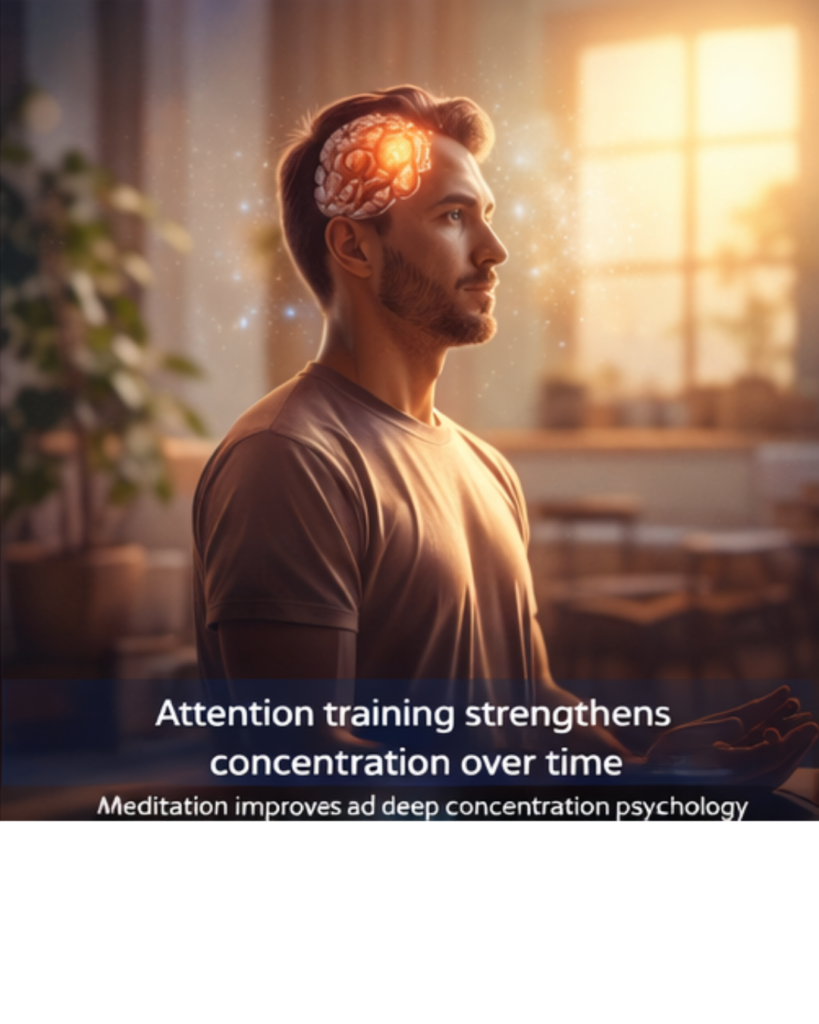
To understand the psychology of deep concentration, you must understand how your brain handles attention.
Three key systems are involved:
1. Prefrontal Cortex (The Control Center)
The prefrontal cortex is responsible for:
- Decision making
- Planning
- Impulse control
- Sustained attention
When you concentrate deeply, this region is highly active.
However, it consumes a lot of energy. That is why deep focus feels mentally tiring.
2. The Dopamine System
Dopamine controls motivation and reward anticipation.
When you:
- Receive a notification
- Watch short videos
- Scroll social media
Your dopamine spikes.
High-frequency dopamine stimulation makes slow, difficult tasks feel less rewarding.
This is why distraction feels easier than concentration. The psychology of deep concentration is directly linked to dopamine regulation.
3. The Default Mode Network (DMN)
The DMN activates when your mind wanders.
If not controlled, it causes:
- Daydreaming
- Overthinking
- Anxiety
- Loss of focus
Deep concentration requires temporarily quieting the default mode network.
Why Distractions Feel So Powerful
Distraction is not weakness. It is biology.
Your brain evolved to detect novelty and potential threats. New information signals survival importance.
Modern technology hijacks this system.
Every notification triggers:
- Curiosity
- Anticipation
- Dopamine release
This creates a loop:
Stimulus → Dopamine → Habit → Craving → Repetition
Over time, your brain prefers quick stimulation over sustained effort.
The psychology of deep concentration explains that to rebuild focus, you must reverse this conditioning. Mastering the psychology of deep concentration gives you a competitive advantage.
The Flow State: Peak Deep Concentration
Flow is a psychological state where:
- Time feels distorted
- Self-consciousness disappears
- Performance increases
- Effort feels effortless
Flow happens when:
- The task is challenging but achievable
- You have clear goals
- You receive immediate feedback
- Distractions are eliminated
Flow is not magic.
It is structured deep concentration.
To enter flow more often, you must design your environment intentionally.
Cognitive Load and Mental Fatigue
Deep concentration consumes cognitive resources.
Your brain has limited working memory capacity.
When overloaded with:
- Multitasking
- Notifications
- Excessive decisions
Your cognitive load increases.
High cognitive load reduces attention span.
The psychology of deep concentration shows that reducing unnecessary decisions improves focus dramatically.
This is why minimalism supports productivity.
Emotional Barriers to Deep Concentration
Focus is not only cognitive. It is emotional.
Many people struggle with concentration because of:
- Anxiety
- Fear of failure
- Perfectionism
- Overthinking
- Self-doubt
When your mind is emotionally unsettled, it seeks escape through distraction.
Deep concentration requires psychological safety.
You must reduce internal noise before expecting external focus.
Habit Formation and Attention Span
Attention is trainable.
Every time you switch tasks quickly, you train your brain to avoid discomfort.
Every time you sit through discomfort and continue working, you strengthen focus pathways.
Neuroplasticity allows the brain to adapt.
If you constantly consume short-form content, your brain adapts to short bursts of attention.
If you practice sustained reading or studying, your brain adapts to longer focus cycles.
The psychology of deep concentration is directly linked to habit repetition.
The Role of Environment in Focus
Your environment shapes your psychology.
Cluttered desk = cluttered mind.
Noisy space = divided attention.
Phone nearby = constant temptation.
To improve deep concentration:
- Keep desk minimal
- Remove unnecessary tabs
- Use website blockers
- Keep phone in another room
Environmental design reduces willpower dependence.
The 5 Psychological Principles of Deep Concentration
1. Single-Task Commitment
Multitasking is a myth.
The brain switches rapidly between tasks, reducing efficiency.
Commit to one task at a time.
2. Clear Objective
Vague goals weaken concentration.
Instead of:
“Study chemistry.”
Say:
“Complete chapter 3 practice questions.”
Clarity strengthens focus.
3. Time Limitation
The brain works well with time boundaries.
Use:
- 60-minute blocks
- 90-minute deep work sessions
Deadlines increase intensity.
4. Dopamine Management
Delay high-stimulation activities until after deep work.
This restores natural motivation.
5. Recovery Periods
Focus cannot be infinite.
Short breaks prevent burnout.
Psychological Techniques to Build Deep Concentration
Technique 1: The Discomfort Rule
The first 10–15 minutes of focus are uncomfortable.
Do not quit during discomfort.
Push through initial resistance.
Technique 2: Attention Training
Practice:
- Meditation
- Breath awareness
- Single-task reading
This strengthens attention control.
Technique 3: Visual Cue Anchoring
Create a ritual:
- Same desk
- Same chair
- Same start time
Your brain associates the environment with focus.
Technique 4: Reduce Cognitive Friction
Prepare everything before starting:
- Notes ready
- Water nearby
- Phone removed
Preparation reduces excuses.
Deep Concentration and Identity
Psychology shows identity drives behavior.
If you believe:
“I have low attention span,”
you reinforce distraction behavior.
Instead build identity:
“I am someone who can focus deeply.”
Small wins reinforce this identity.
Long-Term Effects of Deep Concentration
Practicing deep concentration improves:
- Memory retention
- Learning speed
- Problem-solving ability
- Emotional stability
- Confidence
Over months, you notice stronger mental endurance.
Focus compounds.
Common Myths About Deep Concentration
Myth 1: Some People Are Naturally Focused
Reality: Focus is trained.
Myth 2: You Need Motivation
Reality: Structure creates focus, not motivation.
Myth 3: Multitasking Is Efficient
Reality: It reduces productivity.
Practical Daily Structure for Deep Concentration
Morning:
- No phone first 30 minutes
- Light movement
- Define main task
Work block:
- 90-minute deep session
- 10-minute recovery
Afternoon:
- Lighter tasks
Evening:
- Reduce stimulation
- Prepare for next day
Consistency builds psychological stability.
How Long Does It Take to Improve Concentration?
- 7 days: Slight clarity
- 21 days: Habit formation begins
- 60 days: Noticeable endurance improvement
- 90 days: Identity shift
Deep concentration is built slowly.
Frequently Asked Questions (FAQ)
Why can I focus on movies but not study?
Movies provide constant stimulation and emotional triggers. Study requires internal effort.
Is meditation necessary?
Not mandatory, but helpful.
Can attention span be restored?
Yes. Through habit restructuring and dopamine control.
Is coffee required?
Optional. Discipline is stronger than caffeine.
Conclusion: Master the Psychology, Master the Mind
The psychology of deep concentration shows that focus is not luck.
It is:
- Biological
- Habit-based
- Environment-driven
- Emotionally influenced
If you reduce distractions, manage dopamine, structure your time, and train attention daily, deep concentration becomes natural.
In a distracted world, the ability to concentrate deeply is a competitive advantage.
Build it intentionally.
Guard it fiercely.
And your results will reflect your discipline.
According to research published by the National Institutes of Health, dopamine plays a major role in attention and motivation
If you want to master long focus sessions, read our Ultimate Guide to Focus and Deep Work in 2026: Eliminate Distractions and Train Your Brain for Peak Performance